
A Practical Roadmap to Building Financial Knowledge, Confidence, and Long-Term Financial Well-Being
Everyone starts somewhere.
Whether you’re learning how to organize your finances, reduce debt, increase your income, begin investing, or simply make more informed financial decisions, every meaningful financial journey begins with a single step.
At FINNANCES, we believe that lasting financial well-being is built gradually—not through shortcuts, but through knowledge, discipline, thoughtful planning, and consistent habits developed over time.
Many people want to start investing before understanding how to build a budget.
Others focus on growing wealth while still struggling with high-interest debt.
Many simply aren’t sure where to begin.
That’s exactly why this roadmap exists.
Rather than overwhelming you with hundreds of articles, we’ve organized our educational content into a logical learning journey designed to help you understand personal finance step by step.
You don’t need to learn everything today.
You simply need to take the next step.
Your Financial Learning Roadmap
A step-by-step journey to better financial decisions and long-term well-being.
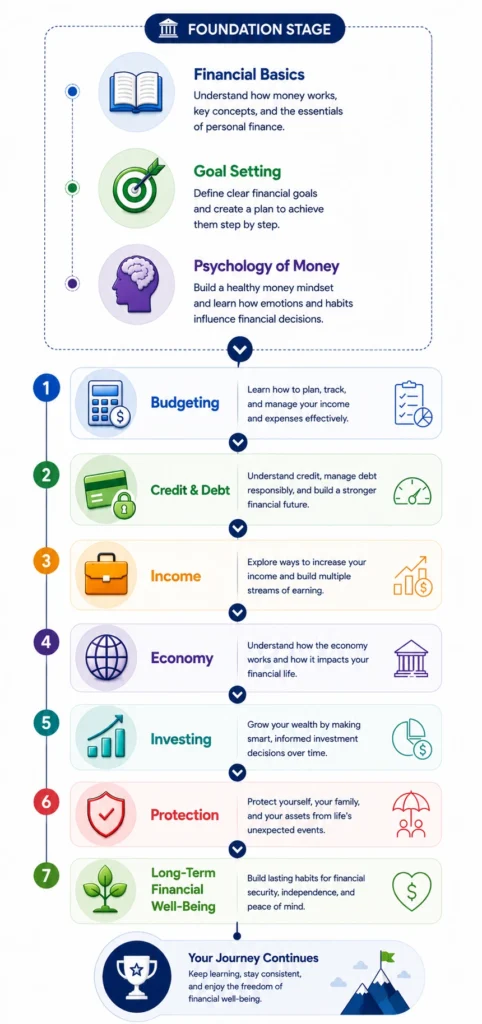
Each stage is designed to build upon the previous one, helping you gradually develop the knowledge, habits, and confidence that support informed financial decisions.
You can begin wherever it best reflects your current situation—or follow the complete journey from the beginning.
There is no perfect pace.
The important thing is to keep learning.
Stage 1 — Build Your Financial Foundation
Every strong financial decision begins with a solid foundation.
Just as a house depends on a strong foundation, long-term financial well-being is supported by knowledge, planning, and consistent habits.
Many financial challenges arise not because people lack intelligence, but because few have had the opportunity to learn personal finance in a structured and practical way.
This first stage was created to help fill that gap.
Here you’ll explore the essential concepts that support every other stage of your financial journey.
🔍 Financial Basics
Everything starts with understanding how money works.
This section introduces the core principles of personal finance using clear, beginner-friendly language.
Topics include:
• Cash Flow
• Net Worth
• Assets and Liabilities
• Compound Interest
• Financial Literacy
• Personal Finance Fundamentals
Understanding these concepts can help you make more informed financial decisions throughout your life.
Goal
Develop a strong understanding of personal finance fundamentals before moving to more advanced topics.
➡️ Explore Financial Basics
🎯 Goal Setting
Financial goals provide direction.
Whether you’re saving for an emergency fund, preparing for retirement, reducing debt, or planning a major purchase, setting realistic goals helps organize priorities and measure progress over time.
Topics include:
• SMART Financial Goals
• Short-Term and Long-Term Goals
• Financial Planning
• Savings Goals
• Debt Reduction Goals
• Retirement Planning
Goal
Transform financial objectives into practical and achievable action plans.
➡️ Explore Goal Setting
🧠 Psychology of Money
Money is not only about mathematics.
Our financial decisions are often influenced by habits, emotions, beliefs, social influences, and behavioral patterns developed throughout life.
Understanding these factors can help us become more aware of how we make financial decisions.
Topics include:
• Emotional Spending
• Lifestyle Inflation
• Scarcity vs. Abundance Mindset
• Financial Habits
• Impulse Buying
• Delayed Gratification
• Behavioral Finance
Developing healthier financial habits can support better long-term financial decision-making.
Goal
Build habits and behaviors that encourage thoughtful and consistent financial decisions.
➡️ Explore Psychology of Money
Your Next Recommended Step
You’ve built the foundation.
Now it’s time to apply these concepts to your everyday financial life.
In the next stage, you’ll learn how to organize your income, control expenses, create a realistic budget, and develop financial habits that support long-term planning.
➡️ Continue to: Budgeting →
Stage 2 — Organize Your Financial Life
Understanding your finances today helps you make more informed decisions tomorrow.
After building a foundation of financial knowledge, the next step is learning how to organize your day-to-day finances.
Financial organization isn’t about restricting your lifestyle or tracking every dollar obsessively.
It’s about understanding your financial situation, identifying priorities, and creating a system that supports better decision-making over time.
The more clearly you understand how your money flows, the easier it becomes to plan for future goals.
📊 Budgeting
A budget is one of the most valuable tools in personal finance.
Rather than limiting your choices, a well-designed budget helps you understand how your income is being used and whether it reflects your priorities.
In this section, you’ll find practical guidance on building sustainable financial habits, improving financial organization, and developing budgeting strategies that can adapt to different lifestyles and income levels.
Explore topics such as:
🏦 Banking Basics
Understand how different types of bank accounts, digital banks, payment methods, debit cards, credit cards, and everyday banking services work so you can make informed financial decisions.
📝 Budgeting Methods
Explore different budgeting approaches, including zero-based budgeting, the 50/30/20 rule, envelope budgeting, and other methods that may help improve financial organization depending on your personal circumstances.
🚨 Emergency Fund
Learn why emergency savings play an important role in financial planning and discover practical strategies for building a financial cushion that can help prepare for unexpected expenses.
💰 Saving Money
Develop practical saving habits, discover strategies for reducing unnecessary expenses, and explore approaches that may help you strengthen your long-term financial planning.
Goal
Develop practical budgeting skills and financial organization habits that support thoughtful financial decision-making.
➡️ Explore Budgeting
Your Next Recommended Step
Now that you have a better understanding of your budget, you’re ready to learn how credit works, how debt develops, and how responsible borrowing can fit into a healthy financial plan.
The next stage will help you understand credit more confidently and avoid common financial mistakes.
➡️ Continue to: Credit & Debt →
Stage 3 — Restoring Your Financial Health
Credit can be a useful financial tool when used responsibly.
Throughout life, many people rely on credit to finance education, purchase a home, manage unexpected expenses, or achieve other important financial goals.
Understanding how credit works can help you make more informed borrowing decisions and recognize situations where debt may require additional planning and attention.
This stage focuses on financial education—not on encouraging or discouraging the use of credit.
💳 Credit & Debt
This section explains how different forms of credit work and explores practical approaches to managing debt responsibly.
Topics are presented in an educational manner to help readers better understand the financial implications of borrowing.
Explore topics such as:
📈 Credit Cards
Learn how credit cards function, how interest is calculated, how payment timing affects balances, and how responsible use may contribute to better financial organization.
💳 Get Out Of Debt
Explore educational strategies commonly used to organize debt repayment, prioritize financial obligations, and gradually improve financial stability according to individual circumstances.
📊 Credit Score Repair
Understand the factors that may influence your credit score and learn about responsible financial habits that are commonly associated with maintaining a healthy credit history.
🤝 Loans
Compare different types of loans, understand borrowing costs, and learn how to evaluate financing options within the context of your overall financial planning.
Goal
Develop a better understanding of credit, borrowing, and debt management as part of responsible personal finance.
➡️ Explore Credit & Debt
Your Next Recommended Step
As your financial situation becomes more organized, you can begin exploring practical ways to increase your earning potential.
In the next stage, you’ll discover different income opportunities—from freelancing and online businesses to side hustles and the growing digital economy.
➡️ Continue to: Income →
Stage 4 — Expanding Your Financial Capacity
Financial planning often involves both managing expenses and exploring opportunities to increase income.
While budgeting helps improve the way existing income is managed, additional income streams may provide greater flexibility for saving, investing, or pursuing other financial goals.
Different approaches work for different people.
The purpose of this stage is to introduce educational resources covering a variety of income opportunities without suggesting that any single path is appropriate for everyone.
💼 Income
This section explores different ways people generate additional income through employment, self-employment, digital businesses, freelancing, and other legitimate economic activities.
Explore topics such as:
📱 Gig Economy & Apps
Discover how gig economy platforms operate, understand their opportunities and limitations, and learn about factors to consider before participating.
💻 Freelancing & Remote Work
Learn about freelance careers, remote work opportunities, client management, pricing strategies, and practical considerations for independent professionals.
🌐 Online Business
Explore educational content covering digital entrepreneurship, online services, content creation, e-commerce, affiliate marketing, and other internet-based business models.
💡 Side Hustle Ideas
Browse practical ideas for generating additional income based on different skills, interests, available time, and personal objectives.
Goal
Understand different approaches to income generation and explore educational resources that may support your long-term financial planning.
➡️ Explore Income
Your Next Recommended Step
Managing your money is important, but understanding the world around your finances is equally valuable.
The next stage explains how inflation, interest rates, taxes, financial markets, and government policies can influence your everyday financial decisions.
➡️ Continue to: Economy →
Stage 5 — Understanding the Economy Around You
Economic events influence everyday financial decisions more than many people realize.
Inflation, interest rates, employment, exchange rates, government policies, and financial markets all affect personal finances in different ways.
Understanding these concepts doesn’t require an economics degree.
It requires access to reliable information presented in a clear and practical way.
That’s the purpose of this section.
🌍 Economy
This section explains economic concepts using accessible language while helping readers understand how broader economic events may influence everyday financial decisions.
Explore topics such as:
📊 Global Economy
Learn how international economic developments, global trade, monetary policy, and major financial events can influence markets and personal finances.
📚 Key Concepts
Understand essential economic principles such as inflation, GDP, recessions, unemployment, monetary policy, fiscal policy, and purchasing power.
💰 Taxes
Learn the fundamentals of taxes and discover how taxation affects your finances, investments, businesses, and the broader economy through clear, educational explanations.
📈 Markets
Explore how financial markets operate, why prices fluctuate, and how investors, businesses, and consumers may be affected by market movements.
📰 News
Stay informed with educational coverage of important economic and financial developments, accompanied by context that helps explain why these events may matter.
Goal
Develop a broader understanding of the economic environment to better interpret financial information and support informed decision-making.
➡️ Explore Economy
Your Next Recommended Step
Understanding the economy provides valuable context for making financial decisions.
Now you’re ready to explore how investing works, learn about different asset classes, and understand the principles of long-term investing and portfolio building.
➡️ Continue to: Investing →
Stage 6 — Making Your Money Work for You
Investing is not the first step of a financial journey—it’s one possible step in long-term financial planning.
After learning about budgeting, credit, income, and the broader economy, many people become interested in understanding how investing works.
Investing can play different roles depending on an individual’s objectives, financial circumstances, risk tolerance, and time horizon.
For some people, investing may support long-term retirement planning.
For others, it may be part of a broader wealth preservation strategy.
Understanding the basic principles before making financial decisions is often just as important as understanding the available investment products themselves.
This section was created to explain investing in clear, educational language so readers can better understand the concepts involved.
📈 Investing
Investing involves balancing opportunities, risks, and long-term planning.
Rather than focusing on short-term market movements, FINNANCES emphasizes financial education, diversification, risk awareness, and informed decision-making.
Explore topics such as:
🌱 Investments for Beginners
Learn the fundamental concepts behind investing, including risk, return, diversification, compound growth, asset allocation, and investment planning.
📊 ETFs & Funds
Understand how exchange-traded funds, mutual funds, and other pooled investment vehicles operate, along with their characteristics and common uses within diversified portfolios.
🏦 Bonds & Fixed Income
Explore how government bonds, corporate bonds, certificates of deposit, and other fixed-income investments work, including their objectives, characteristics, and associated risks.
🏢 Real Estate (REITs)
Learn how Real Estate Investment Trusts (REITs) function, how they differ from direct property ownership, and the role they may play within diversified investment strategies.
👴 Retirement Planning
Discover educational resources covering long-term retirement planning, financial preparedness, and different approaches people commonly use when preparing for retirement.
📈 Stock Market
Understand how stock markets operate, how shares are traded, and which factors may influence market performance over time.
Goal
Develop a stronger understanding of investing principles and long-term financial planning.
➡️ Explore Investing
Educational Notice
All investing content published by FINNANCES is provided exclusively for educational and informational purposes.
Nothing published on this website should be interpreted as individualized investment advice, financial planning, tax advice, legal advice, or a recommendation to buy, sell, or hold any financial product or security.
Every investment involves risk, including the possible loss of principal, and future performance cannot be guaranteed.
Your Next Recommended Step
Building wealth is only part of a long-term financial journey.
Protecting what you’ve built is just as important.
In the final stage, you’ll learn about financial security, insurance, estate planning, and strategies that help reduce financial risks over time.
➡️ Continue to: Protection →
Stage 7 — Protecting What You’ve Built
Building financial stability also involves understanding financial risks.
Managing money isn’t only about earning, saving, or investing.
It’s also about recognizing potential risks and learning strategies that may help protect your finances, personal information, and long-term planning.
Unexpected events, fraud, identity theft, legal matters, and inadequate planning can all affect financial well-being.
This final stage focuses on financial protection through education and awareness.
🛡 Protection
Explore educational resources covering financial security, risk management, and long-term planning.
🚨 Scams & Fraud Prevention
Learn how common financial scams operate, how to recognize warning signs, and practical ways to improve online financial security and reduce fraud risks.
📜 Estate Planning
Understand the fundamentals of estate planning, wills, inheritance, trusts, beneficiary designations, and wealth transfer concepts in different jurisdictions.
❤️ Insurance Basics
Explore how insurance works, the different types of coverage available, and the role insurance may play in managing financial risk.
Goal
Develop a better understanding of financial protection strategies and risk awareness.
➡️ Explore Protection
🎉 Congratulations on Completing the Journey
You’ve now explored the core principles of personal finance—from building strong financial foundations to understanding investing and protecting your financial future.
Remember that financial education isn’t something you finish.
It’s something you continue developing throughout life.
Keep exploring our articles, educational tools, and financial resources whenever new questions arise or your goals evolve.
➡️ Continue Exploring FINNANCES →
Continue Learning with Our Educational Tools
Learning becomes more meaningful when knowledge can be applied in practical ways.
To support your financial education, FINNANCES offers a growing collection of free educational tools designed to help readers better understand personal finance concepts.
Available tools include:
Learn about different investor profiles and understand the factors commonly used to assess investment preferences.
Explore educational planning scenarios that illustrate how savings, investing, and time may influence long-term financial planning.
Evaluate different aspects of your current financial habits through an educational self-assessment.
Estimate an emergency fund based on your monthly expenses and financial circumstances.
Educational Notice
All calculators, assessments, planners, and simulations available on FINNANCES are intended solely for educational purposes.
Results are illustrative estimates based on user-provided information and should not be interpreted as personalized financial, tax, legal, or investment advice.
Keep Learning, One Step at a Time
Financial knowledge is built gradually.
Every concept you understand.
Every question you explore.
Every habit you improve.
Every informed decision you make.
Together, these small steps can help you build a stronger financial foundation over time.
Financial education isn’t about changing your life overnight.
It’s about making better decisions, one step at a time.
No matter where you are today, there is always another opportunity to learn.
We hope FINNANCES will become a trusted companion throughout your financial journey by providing reliable educational content, practical resources, and trustworthy financial information.
Welcome to FINNANCES.
Your journey starts here.
Frequently Asked Questions
Where should I begin?
If you’re new to personal finance, Financial Basics is an excellent place to start.
If you’re primarily focused on organizing your finances, Budgeting may better reflect your current needs.
If debt management is your immediate priority, begin with Credit & Debt.
You can also explore the stage that best matches your current financial situation.
Do I need to complete every stage?
No.
Everyone’s financial circumstances, goals, and experiences are different.
This roadmap is intended as an educational guide rather than a mandatory sequence.
Does FINNANCES provide financial advice?
No.
FINNANCES is an educational platform.
Our content is designed to explain financial concepts and support informed decision-making, not to provide individualized financial recommendations.
Will everyone achieve the same results?
No.
Financial outcomes vary based on many factors, including personal circumstances, economic conditions, financial discipline, experience, available resources, and individual decision-making.
Educational content can improve understanding, but it cannot guarantee specific financial outcomes.